What to check before buying a used e-bike
Okazio editorial team
In brief
A used e-bike is judged on three things: the battery, the legal category, and the condition of the bike itself. In that order — because the battery can cost a quarter of a new bike to replace.
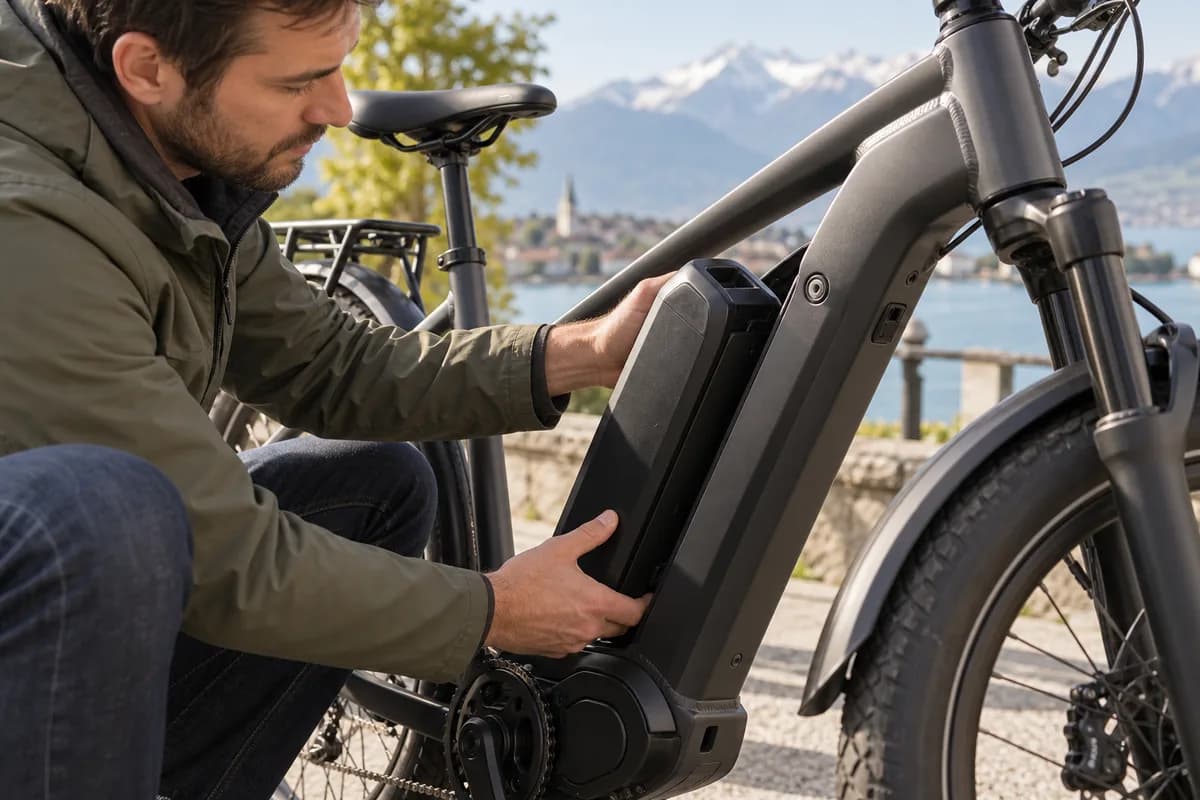
The battery
It is the part that ages, and it ages with the number of charge cycles more than with the years.
What to ask:
- the mileage and the age, together;
- the real range today, on a route the seller knows;
- whether the battery has already been replaced, and when.
What to look at:
- the display, if it shows the battery's state of health or a number of cycles;
- the casing: swelling, a crack or signs of corrosion on the contacts mean the battery is finished;
- that charging starts in front of you, and that the display does climb to 100%.
A battery that has spent winters outside, or been left flat for months, has suffered even with few kilometres on it.
The legal category
In Switzerland, an e-bike belongs to one of two categories, and they do not carry the same obligations.
| Category | Assistance up to | What it means |
|---|---|---|
| E-bike | 25 km/h | Ridden like an ordinary bike |
| Fast e-bike | 45 km/h | Number plate, compulsory helmet, category M driving licence |
Check the category on the frame's type plate before you buy. A fast e-bike without a number plate is not legal, and you are the one who will be riding it.
Watch out too for derestricted e-bikes: a motor modified to go beyond its original speed leaves its category, and loses its compliance and its insurance. A seller who presents derestriction as an advantage is selling you a problem.
The motor and the drivetrain
An e-bike wears out its drivetrain faster than a conventional bike: the motor adds torque to every pedal stroke.
- Pull the chain at the big chainring: if it lifts away noticeably, it is worn out, and so is the cassette.
- Listen to the motor while riding: a knocking sound, a jolt or the assistance cutting out mean expensive repairs.
- Check that the assistance does cut out at the speed of its category.
Brakes and wheels
The weight of an e-bike puts far more strain on the brakes than an ordinary bike does. Look at the thickness of the pads and the discs, and listen when braking.
On the wheels, check for buckling and spoke tension — a loose spoke on a motorised rear wheel means another will follow.
The paperwork
- The purchase receipt, which proves where the bike came from.
- The frame number, to ask for before you travel.
- The dealer's service book, if the bike has one.
An expensive e-bike, with no receipt, at an unusual price: walk away. A stolen bike sold on, even in good faith, ends up being returned, with no refund.
The test ride
Ride for at least ten minutes, with a hill if possible. That is where a battery or motor problem shows up — not over fifty metres of car park.
Sources and method
Additional sources consulted on September 16, 2026.