Start with a realistic model and budget
First define the use: everyday watch, dress watch, sports watch. Note the size that suits you, the type of movement you want (quartz, manual winding, automatic) and the functions that are really useful. A simple, well-documented watch is often safer than a rare model with an unclear history.
To estimate the right price, compare several similar listings on okazio and elsewhere. Look at the brand, exact model, age, condition, presence of box and papers, and maintenance costs to expect. A very low price should encourage you to ask questions, not to rush.
- The exact model and its reference, if you can verify it.
- The diameter, thickness and type of strap.
- The stated movement and its last service.
- The box, papers and invoices available.
- Known defects: scratches, replaced crystal, worn strap.
Prepare the meeting and the questions to ask
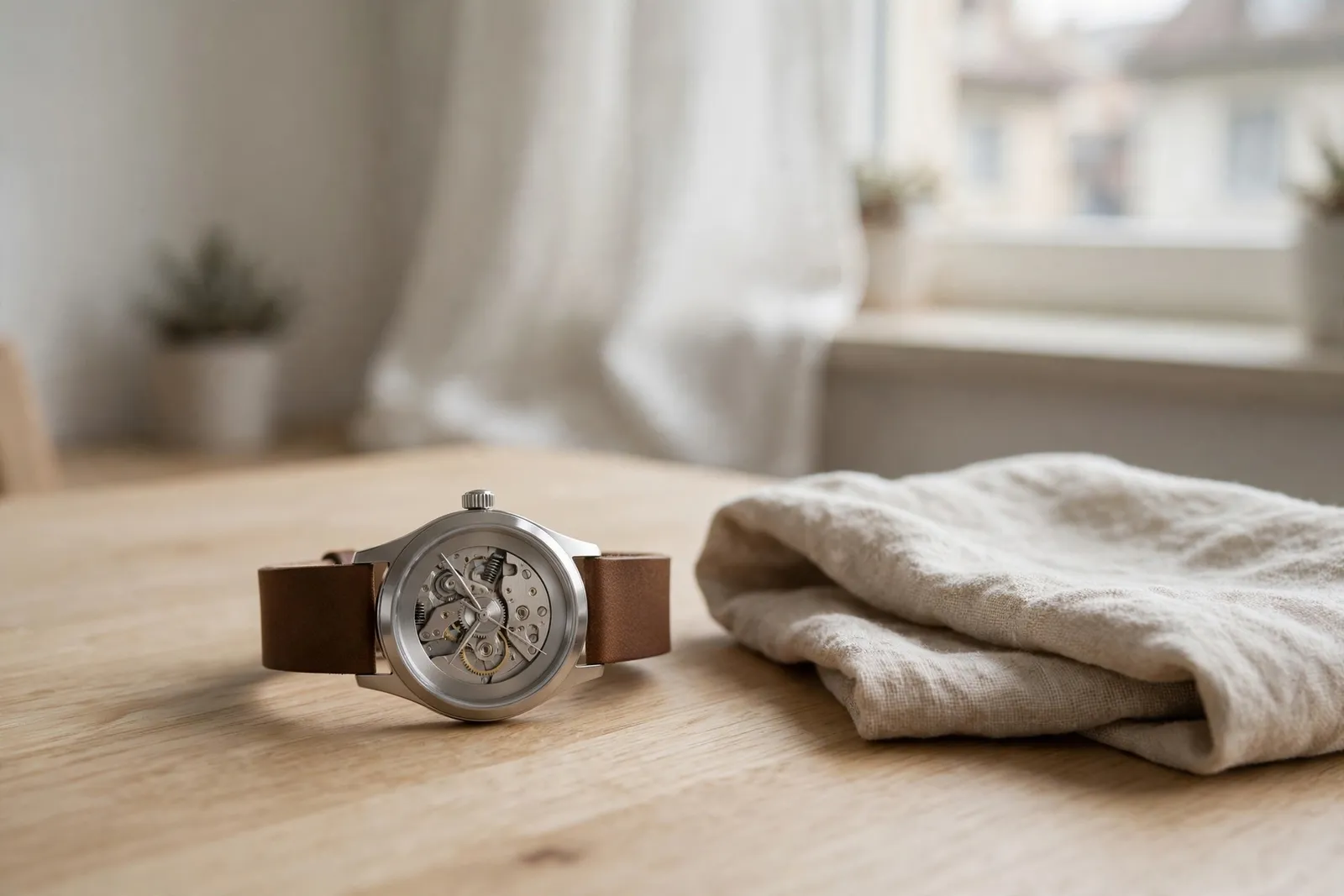
Write to the seller before travelling. Ask for clear photos of the dial, case back, lugs, clasp and, if possible, the movement when the back is transparent. A photo taken in daylight says more than a retouched image.
Ask essential questions without aggression. You are looking for precise answers, not a sales pitch.
- Why are you selling the watch and how long have you had it?
- When was it last serviced and by whom?
- Has it suffered a fall, a repair or a crystal replacement?
- Are the box, papers and invoices present?
- Is the price firm and do you accept a trial before payment?
Set an appointment during the day, in a public and busy place. Bring a lamp, a magnifying glass if you have one, and a soft cloth. Do not pay any deposit remotely and do not pay anything before seeing the watch.

Inspect the case, crystal and lugs
Examine the watch under bright light, then tilt it to reveal scratches. A polished case may have lost its edges, this is not disqualifying, but it should be reflected in the price. Look for impacts, dents on the bezel and signs of opening at the back.
- The crystal: deep scratches, chips on the edge, recent replacement.
- The lugs: deformation, play in the spring bars, marks of an overly tight strap.
- The crown: it should screw or pull out cleanly, without excessive play.
- The case back: tool marks, visible gaskets, even screwing.
- The dial and hands: alignment, halos, missing indices.
Also check that the bezel turns smoothly if it is movable, and that the pushers of a chronograph return properly. A watch originally water-resistant is not necessarily so after years without maintenance. Do not test it under water at the seller's.
Check the strap and clasp
The strap is part of comfort and budget. A supple leather without cracks is easy to replace, but a stretched metal bracelet or a tired clasp costs more to restore. Try the watch on your wrist and operate the clasp several times.
- Leather: cracks, odour, open seams, enlarged holes.
- Metal: play between links, missing screws, scratches on the clasp.
- Rubber or textile: cuts, sweat marks, loose buckles.
- Clasp: firm closure, security that holds, sufficient adjustment for your wrist.
If the strap is too short or too long, ask if spare links are provided. A simple adjustment should not hide a worn clasp.
Test the movement without dismantling it
You do not have to open the watch. A few tests are enough to spot a poorly functioning movement or an overly hurried seller. Do them yourself, calmly, and ask the seller not to handle the watch during the tests.
- Gently wind a manual mechanical watch. The resistance should be regular, without grating or hard points. Never force at the end of winding.
- Set the time, then adjust the date if it has one. The hands should move without jerking and the crown should return firmly.
- For an automatic, wear it for a few minutes or move it gently. The rotor should turn freely when the back is transparent.
- Listen to the ticking near your ear. A regular sound is reassuring, a rattle of a loose part should alert you.
- On a chronograph, start, stop and reset. The hands should return to their starting position without hesitation.
Compare the time with a reliable reference, then check the watch again after a few hours if possible. A slight drift is normal on a mechanical, a sudden stop is not. On a quartz, check that the seconds hand moves regularly and that the battery is not at the end of its life. Ask when the watch was last serviced. A service may be necessary, but you should know the cost before concluding.
Conclude the sale safely
If the watch suits you, do a final test before paying. Check the time, winding, clasp and general condition. Ask for the box, papers and maintenance invoices if they are advertised. A simple receipt, with the date, model and price, can help you keep a record.
- Meet in a public place, during the day, and avoid isolated meetings.
- See the watch before paying, even if the listing seems serious.
- Pay on delivery, in cash or by TWINT, once the watch is in your hand.
- Never send a deposit remotely, even to reserve.
- TWINT never asks for a code received by SMS to receive money. Do not share this code.
On okazio, you can post or search for a listing, then organise the meeting. Payment is made on delivery, between you.
Sources
Prepared with AI tools, checked and proofread by the okazio editorial team.
An unfamiliar word in a listing?
Find its definition, an example and what to check in our glossary.
Explore the glossary