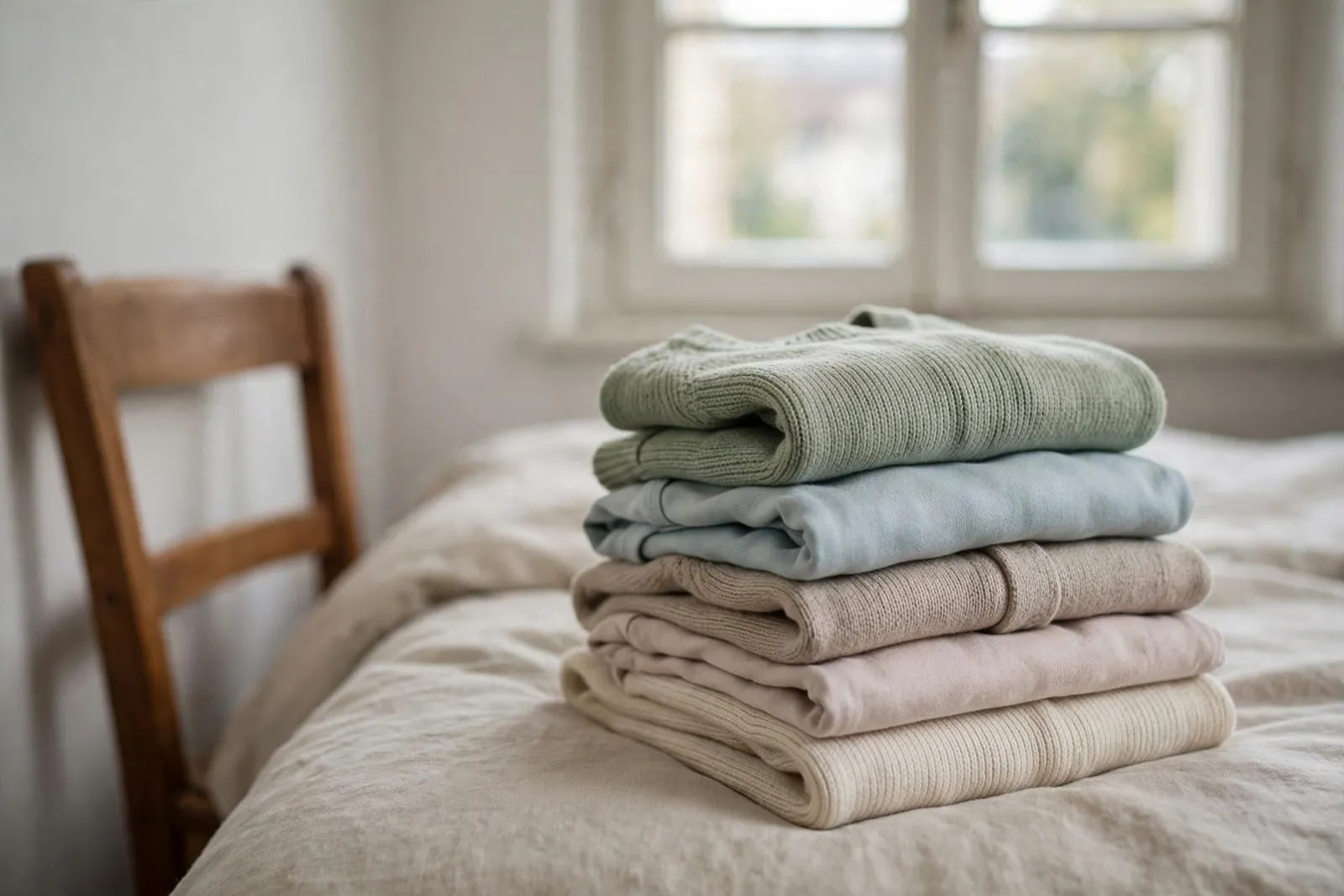
Start by spotting the areas that wear
A children's garment does not wear out in the same way everywhere. The knees of trousers, the seat of leggings, the elbows of a sweatshirt, the cuffs and the lower sleeves take most of the wear. The collar and underarms retain the memory of repeated washing. Look at these places first, first in the photos, then in person.
Good news: many second-hand items have been very little used, because children grow quickly. Others have already been worn by two or three children in the same family. The difference is rarely visible in an overall photo, often in a close-up photo. That is the one to ask for.
Read the listing and ask a few questions
A serious listing states the size, general condition and known defects. If the description is only three words long, write to the seller before you travel. You will save time and avoid a journey for nothing.
- The actual size and the child's age: a 4-year size from one brand does not always match a 4-year size from another.
- The number of children who have worn the item and, approximately, the number of washes.
- The origin: smoking household, pets at home, storage in a damp cellar.
- Defects already identified: stain, tear, missing button, fastener that catches.
- A clear photo of the crotch seams, knees and cuffs.
- The possibility of trying it on at the handover, if your child comes with you.
You can also search for the same category of item on okazio to compare what is selling and at what price level. This gives you a rough idea before you reply to a listing.
Seams, elastic and fastenings: structure first
A stain can be tolerated, a seam that gives way much less. At handover, turn the item inside out and look at the reverse: that is where repairs, pulled threads and tired fabric show.
- Crotch and armhole seams: look for a thread sticking out, a stitch that has come undone, fabric that has gone white along the seam line.
- Waist elastic: it must return into place when you release it. A stretched elastic waistband can be replaced, but it is work.
- Zip: open and close it fully, several times. A slider that catches often signals that it is about to fail.
- Press studs and hook-and-loop fasteners: check that they hold and that the tape still grips.
- Drawstrings and ribbons: those at the neck and hood catch on everything and present a risk. Better to remove them.
- Lining and pockets: run your hand inside to feel for holes and seams that are giving way.
Stains and odours: know when to walk away
Some stains come out in the wash, others are set by the tumble dryer. An old grease or chocolate stain, or yellowing under the arms or at the collar, will probably not disappear. No one can guarantee it, and you will have no recourse once you have taken the item away.
- Grey or shiny area on a knee: the fabric is worn, it is not just dirty.
- Yellowing at the collar and underarms: residues of cream or deodorant, often stubborn.
- Traces of felt-tip pen, ballpoint pen or paint: rarely reversible on light cotton.
- Smell of cigarette smoke, stale air or damp: impossible to judge from a photo, decisive at handover.
- Shiny iron marks on polyester: they do not come out.
If the seller mentions a stain themselves, assume that it will stay. You will then be buying the item for home or for messy play, not for school.
Materials: wear that you cannot see from a distance
At the same size, two items can have a very different lifespan depending on the material. A photo from a distance shows neither the pilled inside of a sweatshirt nor padding that has become compressed in one corner.
- Cotton fleece and sweatshirts: the pilled inside loses its softness, the ribbed edges stretch out.
- Polar fleece: the fibres flatten and the warmth goes.
- Fine jersey: it loses shape at the knees and elbows, the collar stretches.
- Jeans: whitened knees, pocket seams that give way, worn zip.
- Quilted jacket: check that the padding has not clumped on one side.
- Waterproof jacket and swimsuit: a worn water-repellent surface or stretched elastane cannot be restored.
Sizes: the child first, the label second
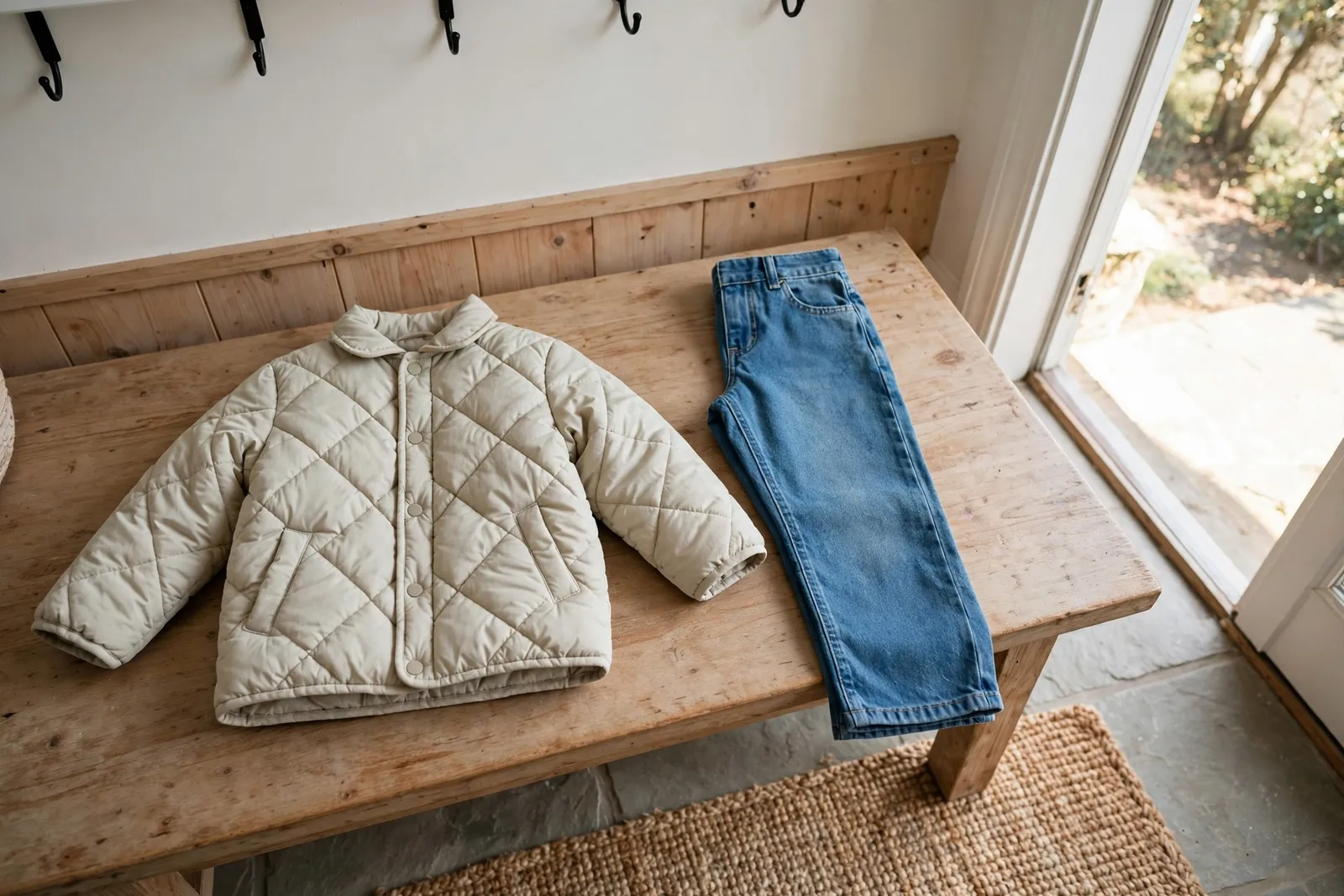
Children's sizes in centimetres indicate height, not age. A 104 corresponds to a child of about 104 cm, but the cut changes a lot from one brand to another. Take the size your child wears today, measure a garment that fits well and compare it with the details in the listing.
High-waisted trousers or a loose sweatshirt will be worn for longer than a fitted item. An item bought one size up will be worn the following year, not straight away: useful if you are building a stock, useless if you are looking for something to wear this week.
For a bundle, check that the sizes and seasons are consistent. A bundle of ten items of which six are too big is not a good deal, even at a low price. The price of a second-hand children's garment is generally low: compare several similar listings rather than negotiating blindly, and buy a bundle only if you will wear most of it.
Handover: see, try on, pay on site
- Arrange to meet in a public, busy place during the day.
- Look at the item in daylight, turned inside out, seams facing you.
- Have the child try it on if you have brought them: two minutes avoid an unnecessary purchase.
- Pay at handover, in cash or by TWINT, once the item is in your hands.
- Never send a deposit remotely, even to reserve a rare item.
- TWINT never asks for a code received by SMS in order to receive money. If someone asks you for one, it is an attempted scam.
Between private individuals, in principle you have no right of return or exchange. The statutory warranty for defects (Art. 197 et seq. CO) applies by default, but it can be excluded by mutual agreement. Defects visible during a careful examination are in principle not covered (Art. 200 CO). What you see at handover is what you take away, unless a hidden defect that has not been excluded appears later. An honest seller will accept this discussion without taking offence, and will let you turn the jacket over and look at the crotch of the trousers.
Sources
Prepared with AI tools, checked and proofread by the okazio editorial team.
An unfamiliar word in a listing?
Find its definition, an example and what to check in our glossary.
Explore the glossary